
THINKING ABOUT MEETINGS
We believe the world works better when people meet better. That’s why we share the things we’ve learned, the methods we’ve discovered, and the mistakes we’ve made.
Check back here soon, as we’ll be posting videos, more articles, and a selection of downloadable tools for you to use.
Build Teams by Building Games
Give Filament's Game Building Exercise a spin if you’d love a creative activity that drives engagement and creative problem-solving while keeping everyone talking about an important topic or idea.
Here’s how it works:
First, run to your local thrift store (Goodwill, Salvation Army, etc.) and buy about a dozen used board games. You can also ask your team to "donate" old games they no longer play to the cause.
Next, separate all of the playing pieces of the board games (cards, tokens boards, etc.) and place everything on a large table. Add blank notecards, poster boards, markers, crayons, scissors, glue, and anything else fun and crafty to the mix.
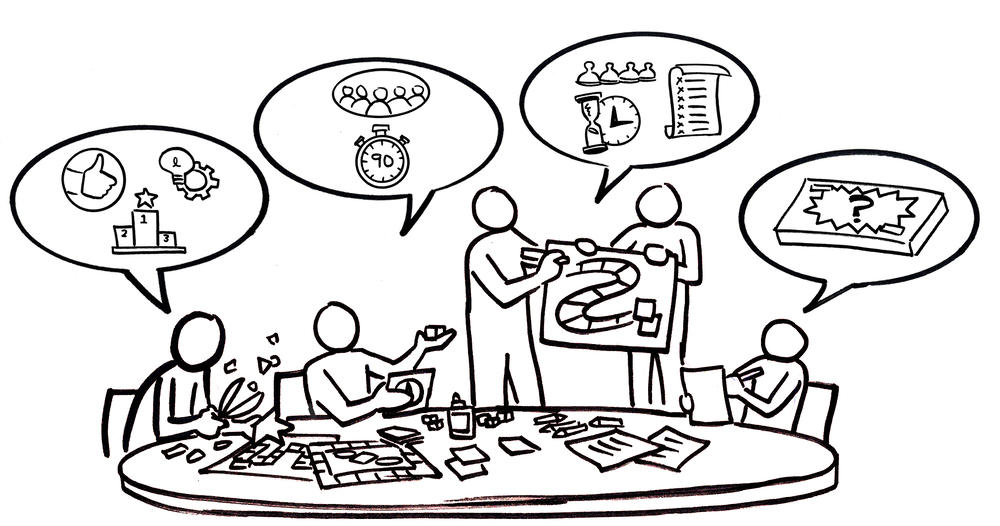
Once your group arrives, divide them into groups of 4-6 and tell them each team has just 90 minutes to build a board game, using as many of the parts and supplies from the table they want.
Then give them these instructions :
Your board game must be about ________________. Select a theme relevant to your team’s work, such as customer service, innovation, beating your competitors, etc.
The game must be playable by at least four people in less than an hour.
Your team must give the game an awesome name.
It can have no more than seven rules. This constraint is the most important part!
After everyone has built their games, each team must “pitch” their game to the room.
Award prizes for the best/silliest/most unique game(s).
Finally, if time allows, break into new teams (leaving one of the original designers with each game to help everyone else understand the rules) and play!
Apart from a really fun time, the conversations during the game-building will uncover insights about your theme and will generate great ideas you’ll keep discussing long after the game play is finished.

Experiment Small First
We work in “experiments” all the time with our customers, asking them to identify simple, cheap, fast, and easy things they can try to improve processes, increase communication, etc.
However, it isn’t always easy for people accustomed to working in large organizations to think small enough, so they regularly propose much larger experiments than necessary.
A few weeks ago, we shared a simple framework that has helped to shrink our customers’ experiments to just the right size.
Here’s how we describe experiments now:
An experiment is smaller than a pilot which is smaller than a project which is smaller than an initiative.
The moment we shared this hierarchy, everyone began thinking about experiments as we’d hoped they always would, and they leave with actionable steps they can take as soon as their meeting’s done.

47-Minute Meetings
Shortening your hour-long meetings to 47 minutes keeps you from back-to-back meetings and gives you time to breathe and prepare.
If you can’t make your meetings better, at least make them shorter.
They lurk in every organization like sneaky assassins: ninja-like time thieves spying on your calendar, waiting to pounce on any open “availability” so they can plug it with an Outlook invite for an hour-long meeting you didn’t see coming.
These unsolicited invitations clog your calendar, giving you another back-to-back-to-back-to-back day with zero time left to get real work done.
And while you may not be able to keep others from taking your time, you can make it a bit harder for them to steal all of it when you schedule all your hour-long meetings for 47 minutes instead.
Here’s why:
First, few meetings need an entire hour. If you have a regular sixty-minute meeting, odds are you can focus a bit more and get it done in only forty-seven.
Second, by making your meetings a weird length, you force others to think twice (and do some math) before booking you in a back-to-back. The moment a meeting ends at 10:47, you’ve got at least 13 minutes before the next one because nobody else wants to invite others to a meeting that begins at 10:48.
Third, by beginning your 47-minute meetings at an odd time (like 9:37), you’ll buy some time before and after for both yourself and your attendees.
The 47-minute meeting isn’t rocket science, but by getting outside the box of hour-long meetings, you’ll retain some control over your calendar and regain some sanity in your work day.

Building a Better Brainstorm
Edit excerpt before publishing.

NOTE: THIS IS A PLACEHOLDER POST GENERATED BY ROBOTS. HUMAN CONTENT IS COMING SOON!
Brainstorming is a crucial part of the creative process, as it allows a group of people to develop new ideas and solutions to problems. However, it can be challenging to facilitate a brainstorming session that is comfortable and productive for both introverts and extroverts.
One way to make brainstorming more inclusive is to provide options for participation. While some people may prefer to speak up and share their ideas out loud, others may prefer to contribute through writing or drawing. Allowing people to choose how they want to contribute can make the session more comfortable for everyone.
Another way to make brainstorming more effective is to assign homework beforehand. This can be as simple as asking participants to spend a few minutes thinking about the problem or challenge at hand before the session begins. This can help ensure that everyone comes to the session with a few ideas already in mind, which can help the discussion get off to a strong start.
Quiet brainwriting is another technique that can be helpful for introverts in particular. In this method, participants are given a set amount of time (such as ten minutes) to write down as many ideas as they can. This can be done individually or in small groups. The ideas are then shared and discussed as a group, which can help introverts feel more comfortable sharing their thoughts.
Overall, the key to having a super creative brainstorming session is to create an inclusive and comfortable environment where everyone feels welcome to contribute. By providing options for participation and utilizing techniques like homework and quiet brainwriting, it is possible to facilitate a productive and enjoyable brainstorming session for people of all personality types.

Rethinking Virtual Vendors
As everyone has moved to virtual conferences, we've figured out how to present and how to network reasonably well. However, there's a gigantic problem we've not solved yet: how do we deliver value to vendors in these virtual events?
"Why care about the vendors?" you might ask. I'll tell you why: they're the reason your event ticket didn't cost 3-5 times more than it did, and they're also why your nonprofit conference organizer stays solvent and delivers value to you year-round. And after nearly 7 months of virtual conferences, most of them are pissed. They're not getting the same ROI as before because nobody wants to wander a "virtual" vendor hall and download a whitepaper -- especially when you don't get a 20-cent pen in exchange. ;-)
So what can conference organizers do? Stop trying to "replace" the vendor hall with a virtualized version of the exact same thing. Instead, think differently about what your vendors and partners want for their dollars and how that might overlap with your attendees' needs.
Here's one way:
First, survey your attendees 3-4 months before the event and find out what they'd like to know and what kind of challenges they're hoping to solve with the things your sponsors/vendors might happen to sell.
Next, synthesize all of those challenges into a bunch of "How might I ..." challenges (such as, How might I migrate my aging, on-premises X to a cloud-based Y?) and then group them into as many logical categories as you can.
Then, send the challenges to your vendors. Tell them they can address as many as they like but will have to pay $ X,000 for each or XX,000 to address all in a category.
Two weeks before your conference, schedule dozens of 20-minute "Challenge Showcase Sessions" that are tied to the "How might I..." challenges you've built. In each, up to 20 vendors who believe their products/services address each challenge can present for one minute apiece.
Publicize the hell out of these sessions to your attendees, but don't require registration for people to attend. During each, the vendor uses their minute to share how their solution addresses the challenge (or to trash their competitors -- after all, it's their minute).
As each vendor presents, share a link that allows session attendees to book five more minutes with them -- but no longer -- to learn a bit more, get a downloaded brochure, share contact details for a Starbucks card, etc. Make sure your vendors adhere to this time limit!
Gamify the Showcase Sessions, awarding prizes for the funniest/weirdest/best one-minute pitches as voted on by the attendees. Build a "best-of" highlight reel. Give away cool attendance prizes to the attendees (iPad, anyone?) of each Showcase Session, etc.
Rinse and repeat for all the challenges. Then, invite your vendors to attend any virtual sessions at your conference that address their focus areas and carve out some time for them to speak since they're not "stuck" on the vendor floor like they are in real events, right?
Finally, don't expect the same people who run your real-world exhibit hall to pull this off -- their expertise lies elsewhere. Hire an expert facilitator instead — and yes, we’re happy to help (just in case you’re wondering).
Originally shared on Twitter, here.